Beyond Prevention: What Cybernetics Teaches Us About AI-Era Controls
For decades we've measured control maturity by one yardstick: more automation, more prevention. But a perfectly optimized control can stay "effective" right up until it fails catastrophically. A 70-year-old theory, cybernetics, points to what comes next in the age of AI.
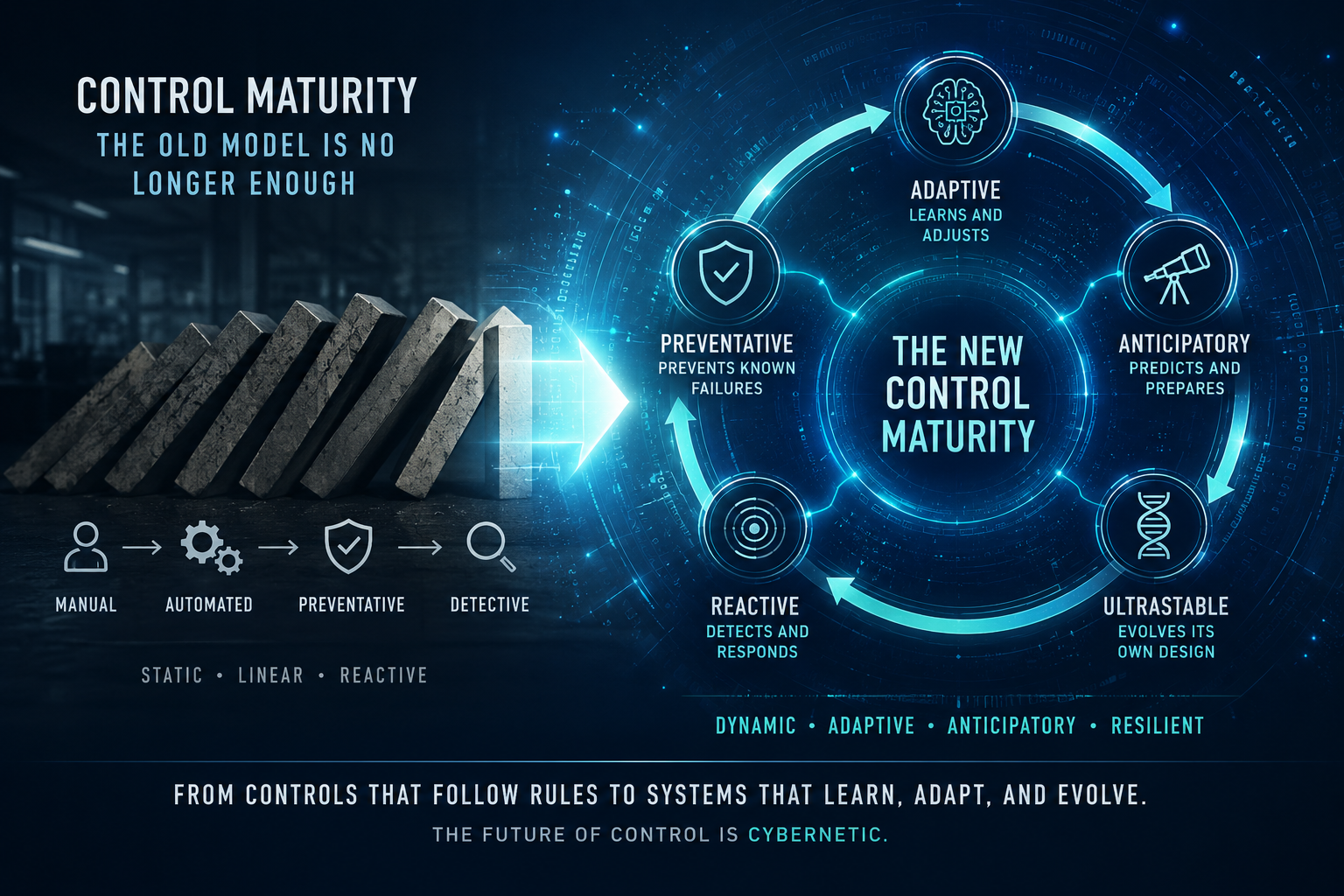
For most of the last century, internal auditors have worked from a tidy hierarchy of control maturity. Manual controls rank below automated ones; detective controls rank below preventative ones. The implied trajectory is clear: strip out human intervention, automate the decision, stop the problem before it happens, and maturity climbs.
That model served us well for a long time, but it was built for a world of stable processes, predictable risks, and slow change. As AI works its way into core business processes, it's worth dusting off a body of theory that has been sitting in plain sight for seventy years and never quite entered mainstream audit thinking: cybernetics. The next stage of control maturity may have less to do with automation than with something more demanding, systems that sense, learn, adapt, anticipate, and ultimately redesign themselves.
The limits of the traditional model
The conventional hierarchy treats controls as machinery for preventing errors. A manual reconciliation becomes an automated one. A detective review hardens into a preventative validation rule. The closer the environment gets to perfect prevention, the reasoning goes, the more mature it is.
Real systems rarely cooperate. Modern organizations operate amid rapid technological change, shifting cyber threats, tangled supply chains, moving regulatory targets, and AI-driven decisions that interact in nonlinear ways. In that kind of environment, failures tend to emerge from conditions no one modeled when the control was designed. A flawless preventative control can still fail badly once the assumptions beneath it go stale.
So the question worth asking shifts. Not "Can this control prevent failure?" but "Can this control keep the system effective when the environment changes?" That second question is, at its core, a cybernetic one.
A forgotten body of theory
The ideas aren't new. The groundwork was laid in the 1940s and 50s by Norbert Wiener, W. Ross Ashby, and Stafford Beer, who defined cybernetics as the study of control and communication in machines, organisms, and organizations. Their central insight still cuts: a control system shouldn't be judged solely on its ability to prevent deviation, but on its ability to stay viable in spite of disturbance.
The human body is the cleanest illustration. The immune system doesn't keep pathogens out. The nervous system doesn't hold the environment still. The body stays healthy because it continuously detects, interprets, and responds through countless interlocking feedback loops. Health is a product of adaptation, not prevention — and the same holds for organizations.
Why it never took hold
If the theory is seventy years old, why didn't it become central to audit practice? Mostly because the technology wasn't there. For most of business history, organizations lacked the data, compute, and connectivity to run sophisticated feedback systems at any scale. Controls had to be static. Designers chose their rules up front because systems couldn't observe themselves and adjust on the fly. So the profession settled on a simpler story, manual to automated, detective to preventative, not because it was complete, but because the alternative was impractical. That constraint is now lifting.
What AI changes
AI brings a capability traditional controls mostly lacked: continuous learning. An AI-enabled control can pick up new patterns, shift thresholds dynamically, revise risk assessments in real time, fold in new information as it arrives, and flag emerging conditions no one explicitly anticipated.
That moves the conversation from automation to adaptation. An automated control follows the rules. An adaptive control asks whether the rules still make sense. That distinction may turn out to define the next generation of control maturity.
A cybernetic model of control maturity
Instead of ranking controls by automation and prevention alone, it helps to picture maturity as layers of increasing cybernetic capability.
Level 1 - Reactive. The system detects a deviation and responds. Reconciliations, exception reports, incident investigations: the classic feedback loop.
Level 2 - Preventative. The system blocks known bad outcomes. Access restrictions, validation rules, segregation of duties, reducing the odds of failures we already understand.
Level 3 - Adaptive. The system changes its behavior as conditions change. Dynamic fraud detection, anomaly detection, risk-based authentication. The control itself evolves.
Level 4 - Anticipatory. The system acts on predicted future states rather than observed ones. Predictive cyber defense, supply-chain disruption forecasting, forward-looking risk models.
Level 5 - Ultrastable. The system rebuilds its own control architecture when the existing one stops working, an organization redesigning its governance model after a systemic shock, a security program moving from perimeter defense to zero trust, an AI system reconfiguring its decision framework as the environment shifts. At this level the organization doesn't just adapt; it adapts its ability to adapt.
From control effectiveness to system viability
Traditional maturity models ask whether controls perform as designed. Cybernetic maturity asks whether the system stays viable under uncertainty. The distinction sounds subtle. It isn't.
A control can be highly effective and still make the organization more fragile. Picture a beautifully optimized preventative control resting on assumptions that no longer hold: its measured effectiveness stays high right up to the moment it fails catastrophically. Cybernetic controls chase something else, resilience. They assume surprise is inevitable and aim to hold performance together as conditions move.
What this means for internal audit
Auditors may need to widen the questions they bring to a maturity assessment. The familiar ones still matter: is the control automated, is it preventative, is it operating effectively. But alongside them:
- How fast does the control detect a change in its environment?
- How does it learn from failure?
- Can it cope with conditions it was never designed for?
- What feedback loops actually exist?
- How would the organization even know its control design had gone obsolete?
- Is there a mechanism to redesign controls when the assumptions break?
These are cybernetic questions, and they're becoming hard to avoid.
The road ahead
None of this makes the old model wrong. Automation still matters; so does prevention. They've just stopped being sufficient measures of sophistication on their own. The organizations that do well over the next decade will likely be the ones that move past static controls toward genuinely adaptive control ecosystems.
The encouraging part is that we don't need a new science to get there. Cybernetics handed us the theory in the 1950s; AI is finally handing us the tools to use it. The next frontier of control maturity may not be about preventing failure at all. It may be about building organizations that learn, adapt, anticipate, and evolve faster than the risks coming at them.
Comments